Moving to Hong Kong
|
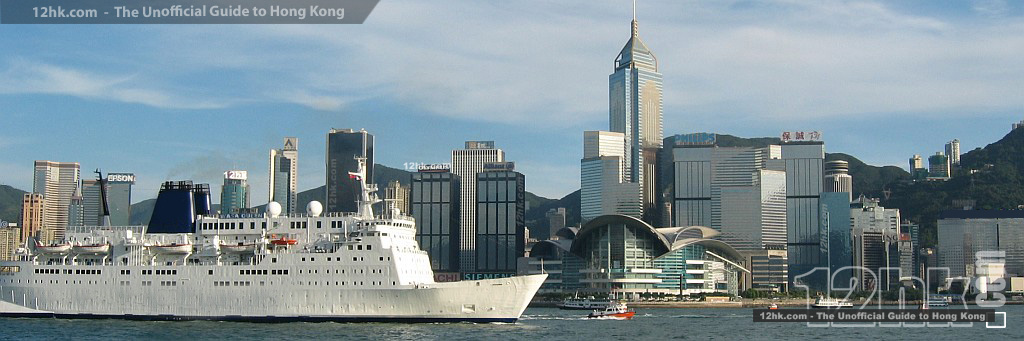
Maybe you'll arrive in one of these after a world tour
|
If you are moving to Hong Kong, here is a typical scenerio: you
visit Hong Kong at the expense of your company.
Then when you move here, you are put up in a serviced
apartment for a couple of months so you can start working
right away and meanwhile look for a place to live.
If you are just hoping to move to Hong Kong, then first on the list
may be to check out the
job market. Knowing Chinese -
either Cantonese or Mandarin, helps in finding a job in HK,
but many expatriates live and work here without knowing much - Chinese, that is.
Here is some information you may find helpful for you to plan
your relocation.
Area
to live in - some popular areas for expatriates are
Mid-Levels,
Happy
Valley, Discovery
Bay, The
Peak, south Hong Kong Island (e.g. Redhill district, South
Horizons),
Sai Kung, Clearwater Bay, Hong Lok Yuen (New
Territories), Pok Fu Lum, Lamma
Island, etc. A tip for making your choice: the pace of life in Hong Kong is fast, so it'll be
good to choose a place with some peace and quietness easily accessible. (see also
living in HK &
housing)
- - decent ones seem to start at US$1025 per
month (as of 2015.2),
but at those prices, you pay on the travel time to central locations of HK.
Those located nearer city center seem to start at US$2000/month.
more about serviced apts
Cost
of living - high, especially in terms of housing!
Food
costs vary. You can find US$6 meals easy enough, and eating in will cost less than that unless you have more exquisite tastes!
Shipping
- to ship your household belongings to Hong Kong, there are
worldwide shippers that can get you a whole container worth
of space or more. (Wouldn't it be nice if
you could just move your whole house - house, yard, and garden?)
They can even provide 'shelf-to-shelf' service: packing from
the shelves you have at your existing home to putting the items
up on the shelves of your new home. But then, your new home
will probably be smaller than your current one because space
in Hong Kong probably costs more, and hence not everything will
fit. (links
to shipping companies)
Electrical
products - Hong Kong household electricity
is 240VAC 50Hz, which means that if you plug your 110VAC (USA)
lamp in directly, it will light up once - very brightly, and
then you may see some smoke. Some appliances may even explode.
If you will be in Hong Kong for just a year and don't
want to buy everything new, you can get "step-down"
transformers once you arrive to convert the electricity. But
some electric clocks may still not work if they work on 60Hz
only.
+
One time I brought back a clock radio from the U.S., plugged it into a step-down transformer, and everything worked - sort of.
Well, the clock ran. The radio worked fine. The only thing was that it loses time by 16%: every hour, it is slower
by 10 minutes. So if it starts
at say 9 a.m., by 12 noon, it tells you it's only 11:30 p.m. And by 5 p.m. actual time, it tells you it's only
3:40 p.m. Not a good clock to have at the office?!
If you want to know why, it's because
unlike electronics which uses internal electronics to keep time (a crystal oscillator being the main component),
it keeps time using the household electrical AC current, which oscillates/alternates at 60Hz in the US.
But the frequency in Hong Kong is 50Hz!
When in doubt, read the label. In fact, read the instructions first
because the transformer may become a step-up one depending on how to flip a switch: changing 220 volts to 440 volts!
Plugging your 110V appliance in may not just light it up, it may set your whole
body alight!
+
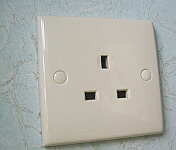 Standard electrical outlet in Hong Kong
-
- there're many schools for English-speaking kids, plus some
for speakers of other languages. Private international schools and 'ESL' schools are the two major
categories popular among expats. more on schools
(links to schools)
Taxes
- compared to many western countries, the income tax is lower.
And there is no sales tax ... yet (as of 2016.5).
If you are an American citizen, you still have to file your
tax return with the IRS. It seems as long as you make below a certain
amount, you won't be taxed other than by the HK government - but don't take our word for it,
you'd better check with your accountant. After all we won't
be responsible for any advice we give here especially when it's
dealing with the IRS! In fact, what we give is not advice, we're just repeating rumors!
Holidays
- in addition to Sundays, Hong Kong has about 15 public holidays each year - actually 17, but some
fall on Saturdays and for most office workers, you get 'cheated'. And the longest
stretch among them is for Chinese New year - 3 days,
after all this is China. You can see the
list here on the government's website.
more about holidays
Banks
- banks outnumber public bathrooms
by a factor of at least 30 to 1, but then of course they serve
entirely different purposes - different deposits. HSBC and the
Bank of China are now the biggest chains, but if you like to
deal with a bank from your own country, I suspect there is one
here although you may not be able to draw funds directly from
your account back home. But then you can probably access one
of the thousands of ATM machines to get what you have with some
kind of finance charge, and even get what you don't have: using
your credit card. But then, it's not as easy to get a HK credit card, so hang on to yours until you qualify!
Domestic
helpers - (aka maids, or to be politically correct,
or butlers) - there are over 300,000 "domestic helpers"
working in Hong Kong.
They are usually from the Philippines or Indonesia on a work
visa. Many of the local and expatriate families have a domestic
worker to help with home chores ranging from cleaning, to child-care,
and to just about anything to be done around the home. They
are normally live-in's. There's a pretty much fixed, flat rate
salary structure, and an employer (you) will also provide the
costs of a trip back to their home country once a year. They
are entitled to take sundays off plus all the Hong
Kong public holidays.
+
There are employment agencies specializing in domestic helpers. They usually do the screening and maybe even the training.
But it's still hard to know whether what's on paper will translate to what is real, so choosing a reliable
agency would be important. And typically, hiring someone who has already worked in HK would be advantageous
since they should have learned the ropes like basic Cantonese (to go shopping in the market), getting around, etc.
Here's some info from the government about hiring domestic helpers.
-
- a great way to get you and your family plugged in, feel
more at home, and establish a support network: Hong Kong life is more than hectic and can be
very lonely. more on churches
(links to some churches)
|
-
- bring them or leave them, here is some info to help you decide. But if for pets you have tigers and lions
and bears, oh my, you'd better leave them and just bring the tin man - but tell him to stay very still and not say a word in front of
people!
more on pets in HK.
- - cell phones in Hong Kong
use a thumbnail-sized SIM card. If yours uses that, you can
probably sign up with a service provider easily and use the
same phone. If you're from US, I understand that once your cell
phone is 'unlocked', you can just get a SIM card here and use
the same phone. But of course don't take our word for it. Verify
it with your carrier first. more on mobile phones & services in HK
Driver's
license - Hong Kong has an agreement with many countries
such that if you have a valid driver's license, you won't need
to be tested in Hong Kong to be allowed to drive. And then getting an
International Driving Permit at your country of residence is another option. But some restrictions apply to both.
(US DL holders:
refer to this page for International Driving Permit
and this page about 'converting' your US driving license.)
Laundry
- Unless you live in Singapore,
Australia, U.K., or other countries that have normal household electricity voltage of 220VAC or thereabouts,
you shouldn't even consider shipping over your washer and dryer. And with the limited space in Hong Kong, your appliances
may not fit anyway.
As for laundromats and dry cleaners, there're plenty in Hong Kong, including a couple of chains.
However, even though many shops say self-service on their signs, I have only seen one that is really self-service
(only at night after they are closed, I think). So by 'self-service' They may just mean that
you bring your dirty laundry yourselves. So if you rely on laundromats to fill your social calendar, good luck!
Typically they charge about US$5 for the initial 6 or so pounds (dirty laundry, that is) and then add
an additional charge per half pound. (Good incentive to check your pockets for coins before laundry!)
And you pick it up later all clean and folded. Usually you have one month to do it. One thing to note:
many shops would add a surcharge for curtains, bedspreads, etc.
For dry cleaning, everything is charged by item. And the prices vary from shop to shop. And although it is called
dry cleaning, some items (e.g. dress shirts) are really just washed normally - but ironed and returned on hangers.
-
- check out the job market and the pay scales. more
Setting up a business
- setting up a business is relatively easy in Hong Kong. And there're plenty of business centers where you can
either rent space or just 'have a presence'. more
Anything else you want to know? Drop
us a line. Questions accompanied with good feedback always
get first priority!
|
|
|
|

 12hk.com